

- Pest Insights
- 28 June 2026
Post-Construction Termite Treatment: 3 Hidden Challenges of Treating Your Home for 'Rimah'
Once you are living in a home, termite (rimah) treatment becomes surgical rather than simple. Here are the three hidden challenges our technicians face drilling and injecting under an occupied villa — and exactly how we solve each one.
On this page
Termites — known locally in the UAE as rimah (الرمة) — complicate life for a lot of homeowners, especially when the infestation is discovered years after you have settled in. At that point, treatment is no longer as simple as it would have been during construction. It becomes a precise operation — closer to surgery on the house than a routine spray.
As a specialist company, we believe in full transparency with our clients. So in this article we share the three biggest unexpected challenges our team faces while injecting floors to treat subterranean termites after a home is built — and how we overcome each one to keep your home safe, dry and intact.
First, the honest context: the cheapest, cleanest termite protection always happens before the slab is poured.
| Pre-construction (PCAT) | Post-construction treatment | |
|---|---|---|
| When it happens | During the build, before tiling | Years after you have moved in |
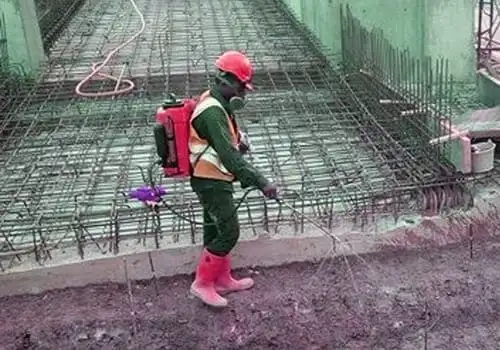
| Method | Soil flooded with termiticide under the slab | Drilling + pressure-injection through finished floors |
| Disruption | None — you never see it | Controlled drilling inside the occupied home |
| Typical cost | Quoted per project | AED 1,500–3,000+ per villa |
| Risk to finishes | Zero | Managed carefully (see below) |
If you are building now, a pre-construction soil barrier is the smartest money you will ever spend on pest control. But most homeowners come to us after the fact — so here is what that job really involves.
1. No utility map for older homes (electrical and plumbing)
The biggest worry for any pest-control engineer is treating an older home whose owners do not have the as-built drawings — the map of water pipes and electrical cables running beneath the floor.
The risks of working blind:
- Punctured water pipes (leaks): Random drilling without knowing what is underneath can crack a main water line under the ceramic, causing mysterious leaks and warped, ruined flooring.
- Electric shock or power loss: A live cable in the drill’s path is a direct danger to the technician’s life, and can short the home’s circuits.
How professionals handle it: We do not rely on luck. When drawings are missing, our team uses modern detection equipment — rebar/metal scanners, cable locators and pipe detectors — to map metal, plumbing and live electrical runs under the floor before a single hole is drilled, guaranteeing a completely safe path for the termiticide.
2. The battle with the concrete slab (floor hardness and drill failures)
To reach the termite colonies sitting beneath the home, we have to use heavy drilling equipment to get through the ceramic and concrete. This is where sudden mechanical challenges appear:
- Extreme slab density: Some UAE homes were built with reinforced, very high-density concrete slabs to withstand the climate, which makes penetration painfully slow and doubles the time on site.
- Jammed drill bits and burnt-out motors: With the pressure and the high heat generated by friction, the drill bit often binds between rebar and concrete and seizes in the floor, or the drill motor fails completely from the strain.
How we deal with it: We always arrive equipped with industrial-grade backup gear, and we use tungsten-carbide and diamond-tipped bits made to cut through the toughest concrete and steel. We drill in staged passes to let the equipment cool, which protects both the tools and the structural integrity of your home.
3. The client’s biggest fear: damaging the look of the home
Every homeowner has the right to worry about how their home looks. When we explain that we will make holes along the walls and inside rooms to inject the treatment, the immediate reaction is usually hesitation — a fear of marking the ceramic or expensive marble.
How we solve this difficult equation: Your peace of mind and satisfaction are our priority, so we follow these steps to return the floor to how it was:
- Tiny, precise holes: We use very fine drill bits that make the smallest possible hole — just wide enough to pass the injection nozzle.
- Smart placement: Wherever possible we drill in spots that are not visible — along the grout lines between tiles, or behind furniture and doors.
- Professional cosmetic sealing: After the treatment is injected successfully, we do not patch the holes with ordinary cement. We use a special filler and grout colour-matched to your existing floor, so the drill marks all but disappear — up to 95% invisible.
What to expect on the day
So you know exactly what you are getting:
- A documented inspection first, with the treatment plan and drill points agreed with you before any work starts.
- Floor and utility scanning before drilling — no guesswork.
- A child- and pet-safe, Dubai Municipality-approved termiticide injected under pressure to form a continuous barrier.
- Colour-matched sealing, a clean-up, and a written warranty on the treated area.
The bottom line: rimah treatment needs experts, not amateurs
Post-construction termite control is not just spraying chemicals. It is an engineering operation that demands advanced equipment, an eye for finishes, and the experience to handle whatever appears under the floor.
If you are noticing signs of rimah in your furniture or walls — and you are not sure what to look for, start with our guide to the hidden warning signs of termites in Dubai homes — do not hesitate to talk to the experts at PestMan. We do not just get rid of the insects; we protect the safety and the beauty of your home.
High-risk, mature-garden communities like Arabian Ranches and Mirdif see this most, and our full villa pest control programme covers it end to end.
Get a free quote in 30 minutes →
Related reading: Hidden termite problems in Dubai homes · What pest control costs in Dubai · How to choose a pest control company