Dubai · Bed Bug treatmentDubaiHigh riskCimex lectularius
Bed Bug Control in Dubai
Blood-feeding nocturnal insects that hide in mattress seams, headboards and luggage — destroying sleep, dignity and hotel reputations. 3-month pest-free guarantee. Based in Deira, Dubai — and serving all 7 emirates.
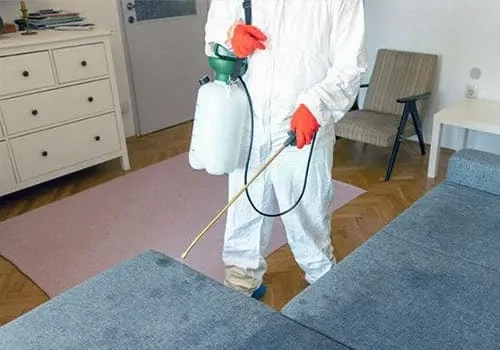
Bed bugs are blood-feeding insects that hide in mattress seams and bed frames, reaching UAE homes and hotels on luggage. PestMan inspects each room, applies a targeted insecticide to seams, cracks and crevices, guides your preparation (including 60°C laundry) and recommends a follow-up about two weeks later at a reduced rate. Backed by our 3-month guarantee. Get a free quote.
The problem
The bed bug problem in the UAE.
Risk · High risk
Cimex lectularius
Active · Active year-round in air-conditioned UAE bedrooms — temperature-independent indoors, Travel-driven spikes around school holidays, Eid travel and DSF visitor season
Bed bugs are the single most distressing pest a UAE family encounters because the bites happen in the most private space — your bed — and the insects can hitchhike home from a single hotel stay, a returning piece of furniture, a child's school bag or a guest's suitcase. Adult bed bugs are the size of an apple seed, hide in cracks no wider than a credit card, and survive 12 months between blood meals — which is why an apartment can sit dormant for a year and re-infest the moment a new tenant moves in. Over-the-counter sprays kill exposed adults but trigger surviving bugs to scatter into adjacent rooms, deeper wall voids and neighbouring units, turning a one-bedroom problem into a four-bedroom problem within weeks. PestMan eliminates bed bugs with a thorough inspection of every harbourage, targeted treatment with a registered insecticide applied into the seams, joints, cracks and crevices where they hide, and a recommended follow-up visit about two weeks later, at a reduced rate, to treat the bugs that hatch from eggs laid before the first visit — all backed by a 3-month pest-free 'sleep assurance' guarantee.
Our technician inspects mattress seams, bed frames, headboards, sofas, skirting, sockets and luggage areas with a torch and bed-bug detection card to find every harbourage.
02
Targeted Treatment Plan
Map every harbourage, agree the preparation checklist with you, and plan crack-and-crevice treatment of the seams and joints where bugs hide — never a room-wide fog.
03
Treatment & Follow-Up Visit
Apply a registered insecticide to seams, joints, cracks and crevices, dust frame voids and install zippered encasement. We recommend a follow-up visit about two weeks later, at a reduced rate, to treat any bugs that hatch from eggs laid before the first visit.
04
Sleep Assurance Warranty
Backed by a 3-month sleep-assurance warranty.
Service tiers
Our bed bug services
01
Residential
Apartment and villa bedroom treatment with our targeted protocol and a recommended follow-up at a reduced rate — backed by a 3-month sleep assurance guarantee.
02
Commercial
Hotels, serviced apartments and labour accommodations — after-hours visits scheduled around guests and residents, tidy and respectful work, and the same targeted protocol, with follow-up visits at a reduced rate.
03
Emergency 24/7
Same-day response for severe bites, infant rooms, immunocompromised patients and pre-arrival hotel inspections — technician on site within hours to inspect and start targeted treatment.
bed bug control guide
What to know about bed bugs
A short, honest field guide — what we look for, how we treat, and how to keep them out for good.
How to identify them
Adults: oval, flat, reddish-brown, 4–5 mm — about the size of an apple seed
Nymphs (immature): translucent cream, smaller, almost invisible after feeding
Eggs: 1 mm milky white grains glued into mattress seams and screw holes
Cast skins: empty translucent shells left behind after each moult
Shed eggs and cast skins cluster in seams, headboard joints and skirting board edges
Signs of infestation
Linear rows of 3–5 itchy red bites on exposed skin (the 'breakfast-lunch-dinner' pattern)
Small rust-coloured blood spots on bed sheets, pillowcases and the mattress label area
Dark inky faecal specks along mattress seams and the back of the headboard
A faint sweet musty almond-like odour in heavily infested rooms
Cast skins (empty shells) accumulating in the box-spring frame and bed-leg joints
Children waking up with fresh bites every morning despite a 'clean' bedroom
Health & safety risks
Severe sleep disruption from nightly itching — recognised by sleep clinicians as insomnia trigger
Allergic skin reactions ranging from small welts to large urticarial patches
Anxiety, social withdrawal and embarrassment — the psychological toll is often worse than the physical
Cost of replacing mattresses, sofas, bed frames and headboards if treated late
Secondary skin infections in children from scratching open bites
Iron-deficiency anaemia in heavily infested rooms (rare but documented in severe cases)
Where you'll find them
Mattress seams, piping, button tufts and label folds
Box-spring corners, wooden bed frame joints and screw holes
Behind the headboard, especially upholstered headboards stitched to the wall
Bedside table drawer rails, alarm clock cracks and book spines next to the bed
Carpet edges, skirting boards and the underside of curtains within 1.5 m of the bed
Luggage seams, school bags, sofa cushions and reading chairs in living rooms
Adjacent apartment walls — bed bugs travel through electrical outlets between units
When they're active
Active year-round in air-conditioned UAE bedrooms — temperature-independent indoors
Travel-driven spikes around school holidays, Eid travel and DSF visitor season
Hotel infestations correlate with seasonal occupancy peaks (Nov–April)
Stored furniture infestations re-emerge instantly when units are reoccupied after summer travel
Our treatment approach
Targeted treatment with a registered insecticide applied into mattress seams, bed-frame joints, headboards and the cracks and crevices where bed bugs hide — not a room-wide fog
Recommended follow-up visit about two weeks later, at a reduced rate, to treat bugs that hatch from eggs laid before the first visit — sprays don't reliably kill eggs, which is why this second visit matters
Targeted residual insecticide on skirting, wall voids and cable penetrations around the bed
Diatomaceous earth dust in bed frame screw holes and box-spring corners as a long-term tripwire
Bagging bedding, curtains, soft toys and clothing for a 60°C wash and 90-minute hot tumble-dry at home, as a parallel step
Mattress and box-spring encasement (zippered, bed-bug-rated) installed same day to trap survivors
Inspection of adjacent rooms and apartments — bed bugs spread laterally through walls
Prevention tips
Inspect every hotel bed on check-in — lift sheets and check the mattress seams and headboard back with your phone torch before unpacking
Never put your luggage on the hotel bed or carpet; use the luggage rack and keep zippers closed
Wash holiday clothes immediately on return at 60°C and tumble dry on high heat for 90 minutes — even if they look clean
Inspect any second-hand mattress, sofa, headboard or cot for cast skins and rust spots before bringing it home (don't bring it home at all if you can help it)
Fit zippered bed-bug-rated mattress and pillow encasements as a long-term insurance policy
Vacuum bedroom skirting and bed frames weekly and bin the vacuum bag in an outdoor bin
Prep & aftercare
Before & after your service
Before your visit
Strip all bed linen, pillowcases, mattress protectors and duvets and seal them in trash bags ready for a 60°C wash + 90-minute high-heat tumble dry
Remove books, magazines, alarm clocks, charger cables and decorative items from bedside tables — bed bugs hide in every crevice
Vacuum baseboards, mattress seams and headboard joints the day before; immediately seal the vacuum bag in a black plastic bag and bin it outside
Move framed pictures and electronics away from the bedroom walls so the technician can reach skirting, sockets and headboard joints
Do NOT apply DIY bed bug spray, foggers or essential oils in the 7 days before our visit — they scatter bugs into adjacent walls and apartments
Brief children gently — everyone, pets included, stays out of the treated rooms until the surfaces are dry, as the technician advises, so plan a cinema, mall or relative visit
After your service
You should stay out of the house for at least 4 hours after residual application; on return, open windows and turn on air conditioners to ventilate fully
Do NOT wash or scrub the treated surfaces — skirting, headboard backs, bed-frame screw holes — for at least 7 days; the residual film needs time to bind and intercept any straggler emerging from an egg
Sleep in the treated room the same night — this is critical; bed bugs are attracted to CO₂ from breathing, so an empty bed lets them escape to other rooms
Leave the new zippered mattress encasement on for at least 12 months — do not unzip it
Re-inspect mattress seams and headboard joints before the follow-up visit using your phone torch; flag anything live, fresh blood specks or new eggs via WhatsApp so the technician can target those spots — after that, any new activity is covered by the 3-month warranty
Vacuum the bedroom every 3 days for the first 30 days and immediately seal each vacuum bag in a black bag bin outside
If returning from any future hotel trip, leave luggage in the bathroom for 24 hours and inspect zippers and seams before unpacking
Dubai communities
Where we treat bed bugs in Dubai
Dubai neighbourhoods where bed bugs are a common problem — each page covers the local buildings, risks and prevention.
The questions we hear most about bed bug control jobs in the UAE.
I think I picked up bed bugs from a hotel — how do I inspect my luggage before I unpack at home?
Take the suitcase straight to the bathroom, NOT the bedroom — bathrooms have tile and porcelain where bugs can't hide. Open the case on the floor on a white towel or sheet. Inspect every zipper seam, the inside lining seams, the wheel housings and the corner reinforcements with a phone torch. Look for live bugs (4–5 mm apple-seed-shaped reddish brown), tiny cream eggs glued in crevices, dark inky specks (faeces), or rust-coloured smears (squashed feed). Empty all clothes directly into a black bag and walk it straight to the washing machine — 60°C wash + 90 minutes on high tumble dry kills every stage of bed bug. Leave the suitcase in the bathroom for 24 hours; vacuum its interior, then place it inside a large sealed bag in the storage room. If you find any live bug or eggs, call us before the case touches your bedroom — early intervention is far simpler than treating an established bedroom infestation.
Do I have to throw out my mattress and bed frame after treatment?
Almost never. We treat the places bed bugs actually hide — mattress seams, piping, tufts, box-spring corners and bed-frame joints — with a registered insecticide applied into the seams, cracks and crevices rather than broadly over the sleeping surface, and recommend a follow-up visit about two weeks later, at a reduced rate, to treat any bugs that hatch from eggs laid before the first visit. After treatment we fit a zippered bed-bug-rated encasement so any cast skins or dead remains inside the mattress can't re-emerge and any future bug can't get in. The only scenarios where we'd recommend replacement are: (1) the mattress is more than 8 years old and end-of-life anyway; (2) heavy faecal staining has soaked into the foam beyond cleaning; (3) it's a deep pillow-top construction where some seams are too deep to treat thoroughly. Bed frames are usually even more straightforward — solid wood, MDF and metal frames are treated joint by joint and screw hole by screw hole, with the follow-up visit catching any late hatchlings. Replacing furniture without proper treatment is wasteful AND ineffective: the new mattress re-infests within weeks because survivors hide in the room itself, not just the bed.
Why do you recommend a follow-up visit for bed bugs — isn't one spray enough?
Three reasons: eggs, hiding places and preparation. Eggs — insecticides do not reliably kill bed bug eggs, so even a careful single treatment leaves the next generation to hatch. That's why we recommend a follow-up visit about two weeks later, at a reduced rate, timed to treat the nymphs that hatch from eggs laid before the first visit, before they can mature and breed. Hiding places — bed bugs shelter in seams, joints, cracks and crevices, so we apply a registered insecticide precisely into those harbourages instead of fogging the room or spraying sleeping surfaces broadly. That's also why shop-bought sprays so often fail: they hit exposed adults and scatter the rest into walls and neighbouring rooms. Preparation — hot-washing bedding and clothes at 60°C, decluttering around the bed and vacuuming before each visit remove many bugs and expose the harbourages we need to reach. Inspection, targeted treatment, the follow-up visit and your preparation at home work together — backed by our 3-month warranty.
How do I tell bed bug bites apart from mosquito bites or a skin allergy?
Three distinguishing features. Pattern — bed bugs feed multiple times in one feeding session, producing 3–5 bites in a straight line or zig-zag along a single exposed area (the famous 'breakfast-lunch-dinner' pattern). Mosquitoes leave single isolated bites scattered randomly. Timing — bed bug bites appear ONLY on skin exposed during sleep (arms, neck, shoulders, ankles); mosquito bites can be anywhere you were uncovered when bitten. Itch onset — bed bug bites often itch most intensely 1–3 days after the bite (delayed reaction), while mosquito bites itch immediately. Plus: bed bug bites recur every morning in the same bed because the bugs live with you; mosquito bites stop when you leave the location. A skin allergy or hives presents as scattered welts of varying size and shape with no pattern. If you wake up with linear groups of bites and your partner does not, you might be sleeping closer to the harborage — switch sides for one night to confirm.
Can bed bugs survive a Dubai summer if I store infested furniture in the garage?
Surprisingly, yes — usually. A closed Dubai garage in July can reach 50°C internally, but bed bugs need a sustained 45°C+ for several hours to die, and the foam core of a sofa or mattress insulates them dramatically. The bugs sit deep in the centre of the cushion where the temperature lags the air by 8–15°C. We've inspected stored furniture left in garages for entire summers that still tested positive in October. Infested furniture needs proper treatment, not a summer in storage. If you're moving abroad or out of an apartment and want to keep an infested mattress, book us first; we'll inspect and treat it in place before it moves. Don't take the gamble of summer storage and don't transport infested furniture in your car — you'll seed the new property.
What's the exact washing protocol for sheets, kids' soft toys and curtains after a confirmed infestation?
Three categories, three protocols. (1) Washable fabrics (sheets, pillowcases, duvet covers, clothing): seal in a closed bag at the source, transport to the washing machine, wash at 60°C minimum, then tumble dry on high heat (above 60°C) for 90 minutes minimum. The dry cycle is the critical kill step, not the wash. (2) Delicate items (silk scarves, dry-clean-only clothes, embroidered cushions): place in a sealed bag in the freezer at -18°C for a minimum of 4 days, then take to a dry cleaner. (3) Soft toys, plush animals and stuffed children's bedding: bag and tumble dry on high heat for 90 minutes without washing if the label allows; otherwise freeze for 4 days. (4) Curtains and full-length drapes: where possible take down and 60°C wash + tumble dry; for non-washable heavy curtains, vacuum the hems and pleats thoroughly and our technician will inspect them during the treatment visit. Never bring un-treated bags back into a treated room.
Are bed-bug-sniffing dogs used in the UAE — and would they help my inspection?
Bed-bug detection canines are an established tool internationally (hotels use them widely in the USA and Europe) and a small number of certified handlers operate in the UAE, primarily working with five-star hotels, serviced-apartment chains and corporate accommodation. For homes the cost-benefit usually doesn't justify a dog: a thorough human inspection with torch, white card and visual sweep finds infestations down to 5 live adults per room. Where canines really excel is in early-detection across a 60-room hotel floor or a labour-camp block — they can clear or flag 50 rooms in an hour where a human team would need a day. If you specifically want a canine sweep of your villa or hotel we can arrange it via our partner team; pricing is per room, with a minimum booking of three rooms.
How do you treat a hotel room for bed bugs without disrupting guests or operations?
We plan hotel treatments around your operations and schedule them during the lowest-occupancy window — usually 2 am to 6 am — when corridor noise won't disturb guests. We inspect the room and the adjacent rooms, apply a registered insecticide to the mattress seams, bed-frame joints, cracks and crevices where bed bugs hide, and recommend a follow-up visit about two weeks later, at a reduced rate, to treat any bugs that hatch from eggs laid before the first visit. The room stays out of service until the treated surfaces are dry, as our technician advises. We work tidily and respectfully throughout.
What do bed bugs look like?
Adult bed bugs are flat, oval and reddish-brown, roughly 4–5 mm long — about the size and shape of an apple seed. After a blood meal they swell and darken to a deeper red. The eggs are tiny milky-white grains around 1 mm long, glued into mattress seams and crevices and easy to miss without a torch, while newly-hatched nymphs are smaller and almost translucent until they feed. You'll also often spot pale empty cast skins shed as the bugs grow, which are a reliable sign they're breeding nearby.
How do I know if I have bed bugs?
The clearest early sign is waking up with itchy red bites in lines or small clusters on skin that was exposed during sleep — arms, neck, shoulders and ankles. Then inspect the bed itself with a phone torch: look for small rust-coloured blood spots on the sheets and mattress label, dark inky specks (their droppings) along the mattress seams and the back of the headboard, and pale shed skins in the bed-frame joints. In a heavier infestation you may find live apple-seed-sized bugs tucked into the seams, piping and screw holes. If you see any of these in your Dubai or Sharjah home, book an inspection before the problem spreads to adjoining rooms.
Where do bed bugs come from, and what causes them?
Bed bugs are hitchhikers, not a sign of a dirty home — even the most spotless villa or five-star hotel room can get them. They almost always arrive on something that comes in from outside: luggage and clothing after travel, a second-hand mattress, sofa or headboard, or a guest's bag. In apartments and labour accommodations they also spread laterally between units, travelling through wall voids, electrical outlets and shared skirting. High guest turnover is why hotels and serviced apartments are especially exposed, which is also why inspecting beds on check-in and treating used furniture before bringing it home are the most effective ways to keep them out.